Sometimes the motorcycle you didn’t ask for turns out to be the one worth talking about
My 2026 Indian Challenger review began with a motorcycle I hadn’t actually requested. When I first agreed to attend the Western Canadian Indian Motorcycle Riders Celebration in Kimberley, British Columbia, I had a particular motorcycle in mind. The Indian Sport Chief RT seemed like a sensible choice. Smaller, equipped with a quarter fairing and considerably less intimidating than a full-sized bagger, it was the motorcycle I had requested for the journey through the Kootenays.
But as it turns out, plans change.
Instead of the Sport Chief RT, I was handed the keys to a 2026 Indian Challenger equipped with the liquid-cooled PowerPlus 112 engine. And this wasn’t just any Challenger. Outfitted with a Bassani 2-into-1 exhaust, Stage 1 performance upgrades, a Lloydz tune and Indian Motorcycle mitered mid-rise handlebars, this particular machine had been customized to make an impression.
In fact, the Challenger was destined for the rally’s Show n’ Shine, where it would be on display among motorcycles belonging to Indian enthusiasts who had travelled from across North America and beyond.
There was just one small detail. Before it could take its place among the show bikes, I was going to ride it.
For this 2026 Indian Challenger review, the winding highways of the Kootenays offered an opportunity to experience how the customized PowerPlus 112 performed beyond the showroom. With the winding mountain highways of the Kootenays ahead of me, I was about to discover whether this imposing American bagger was more motorcycle than I had bargained for—or exactly the motorcycle I needed to experience.
The Walk Around
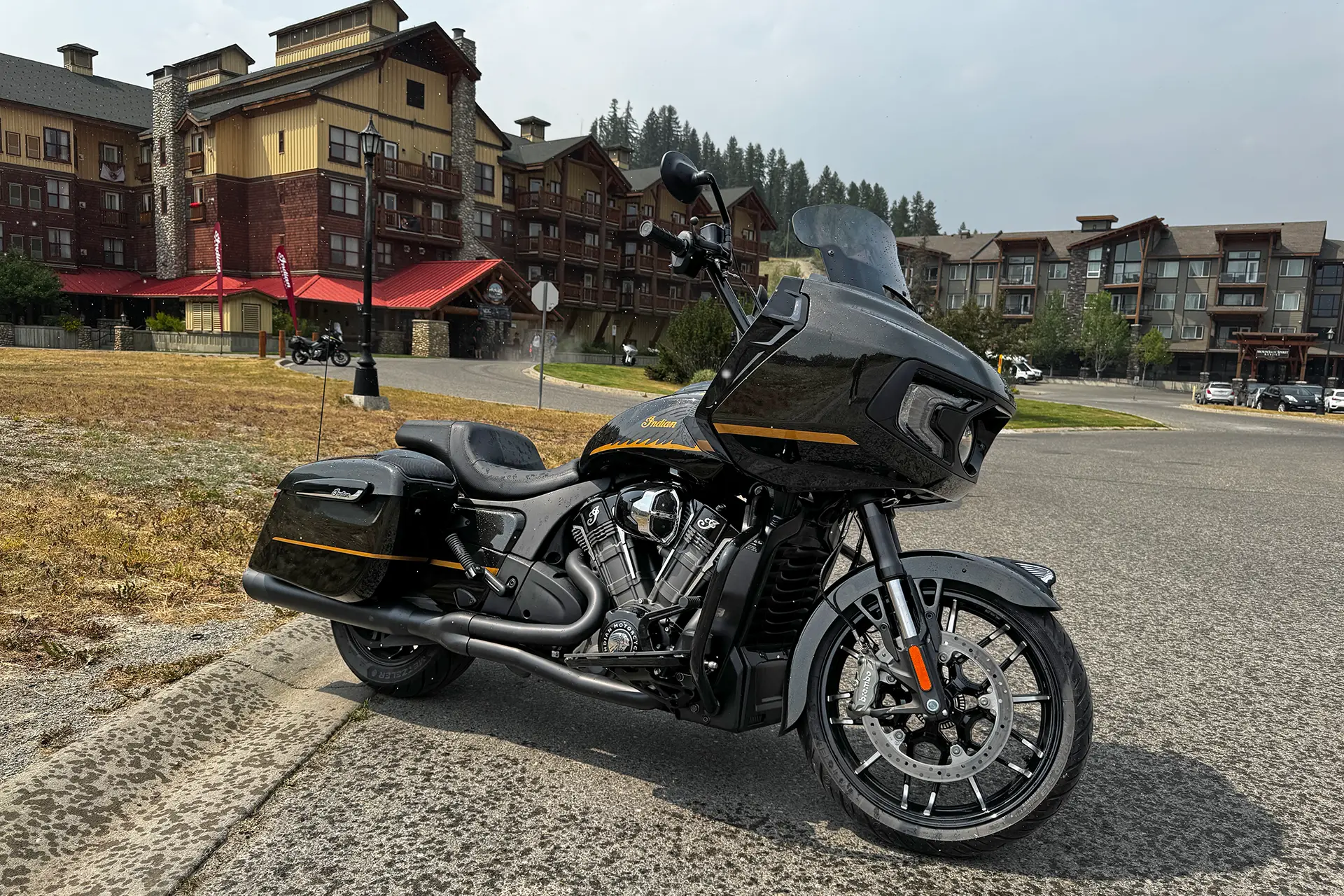
There is no mistaking the Indian Challenger for anything other than a full-sized American bagger. With its broad shoulders, aggressive stance and distinctive frame-mounted fairing, the Challenger commands attention before the engine even comes to life. Compared with the smaller Sport Chief RT I had originally requested, this was a considerably more imposing motorcycle.
The sculpted bodywork flows from the prominent front fairing into the fuel tank, stepped seat and colour-matched hard saddlebags. Its low-slung profile gives it a muscular appearance, while the modern LED lighting and aerodynamic design offer a contemporary interpretation of American touring motorcycles.
And while I hadn’t initially planned on riding the Challenger, apparently my helmet had other ideas.
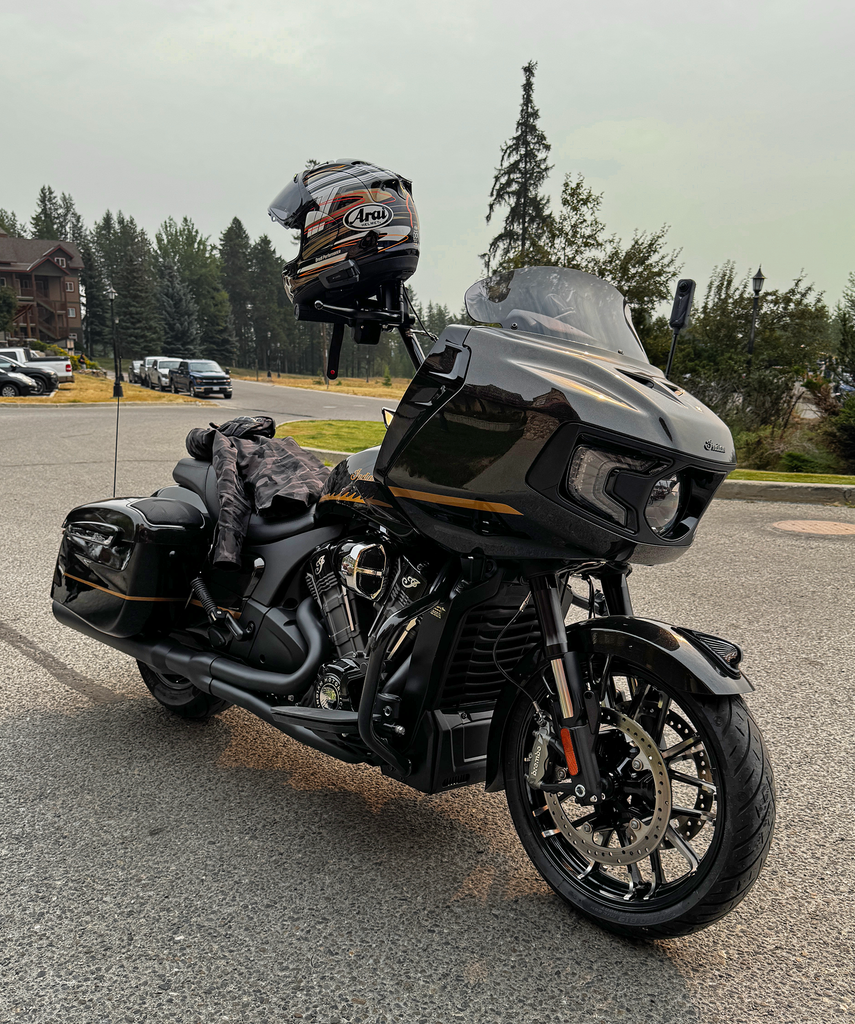
My Arai Corsair-X, sporting the 2026 Isle of Man TT graphic, was an almost perfect match for the Challenger’s charcoal and black paintwork, right down to the gold accents. Pure coincidence, of course, but with the helmet perched above the fairing, you might have thought the two had been coordinated deliberately. At least I was going to look the part.
Of course, this particular Challenger wasn’t exactly fresh off the showroom floor.
Starting at the front, the factory windshield had been replaced with a tinted Klock Werks screen. Its distinctive sculpted profile and raised upper lip are designed to redirect airflow, helping manage wind and turbulence around the rider. Combined with the Challenger’s frame-mounted fairing, the windshield adds another visual element to an already aggressive front end.
The handlebars had also received attention. Indian Motorcycle’s mitered mid-rise bars replaced the factory setup, giving the cockpit a more customized appearance and changing the relationship between the rider, seat and controls. Paired with ODI’s Hart-Luck Signature Series V-Twin lock-on grips, the combination adds another performance-inspired touch to the Challenger’s cockpit. It’s a subtle nod to the custom motorcycle culture that complements the bike’s otherwise sophisticated touring design.
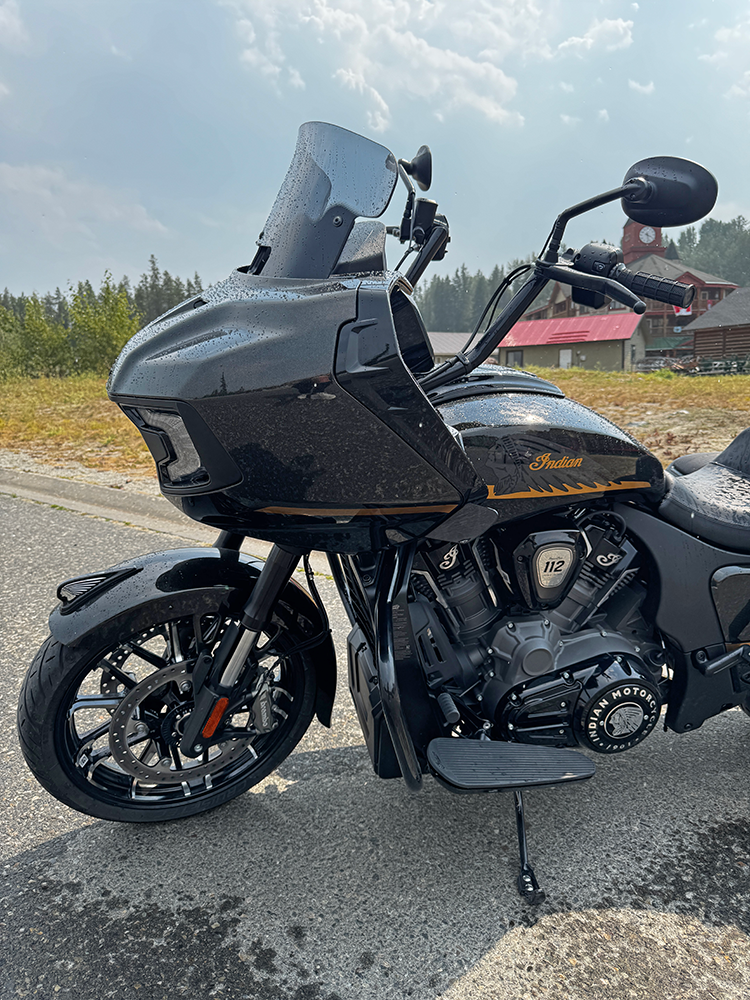
Moving rearward, the factory exhaust had been replaced with a Bassani 2-into-1 system. Its single-outlet configuration gives the Challenger a distinctly different appearance from the standard dual-exhaust arrangement, with a design intended to complement the engine’s performance capabilities.
But not all of the modifications were immediately visible.
The liquid-cooled PowerPlus 112 V-twin had been treated to Stage 1 performance upgrades, including an S&S air filter, along with a Lloydz tune. Together with the Bassani exhaust, these changes were intended to improve the engine’s breathing and refine its power delivery not to mention it’s voice.
Despite its performance-oriented modifications, the Challenger retains the technology expected of a premium touring motorcycle, including Indian Motorcycle’s RIDE COMMAND infotainment system and PowerBand Audio.
I did give the external speakers a test while stationary, and the sound was substantial, with an impressive amount of volume. Personally, I prefer keeping my music inside my helmet through my Cardo PackTalk Edge communication system rather than rather than sharing my playlist with everyone around me (especially when hundreds of motorcycles invade a small town).
What impressed me was the Cardo paired with the Indian Motorcycle system, along with the ease of connecting my phone via Bluetooth. Within moments, everything was connected and ready to go, leaving me free to concentrate on the ride rather than fiddling with technology.
Standing back and taking it all in, I could appreciate why this Challenger had been prepared for the rally’s Show n’ Shine. It was a motorcycle that balanced the substantial presence of an American bagger with a collection of carefully selected custom components.
And with a helmet that just happened to match, there was really no excuse not to climb aboard.
Features and Technology
For all its muscular styling and performance-oriented modifications, the 2026 Indian Challenger is also a sophisticated touring motorcycle, equipped with technology intended to make life on the road a little easier.
At the centre of the cockpit is Indian Motorcycle’s RIDE COMMAND infotainment system, bringing together navigation, motorcycle information, phone connectivity and entertainment through a touchscreen display. It’s an impressive collection of technology, but what matters most is how well it works when you’re actually riding.
During the rally, I decided to take a ride from Kimberley to Fernie to meet an old friend for lunch. It was the perfect opportunity to put the Challenger’s navigation system to the test, travelling independently rather than following a group of motorcycles.
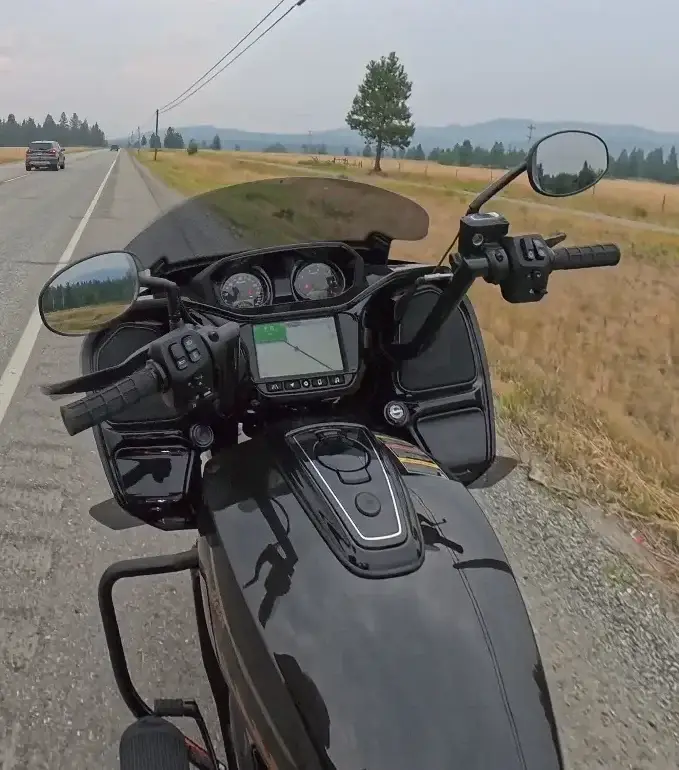
And I have to say, the navigation system was fantastic.
Having the route displayed directly in front of me made the journey straightforward, allowing me to concentrate on the road and the scenery rather than wondering where I needed to turn next. The return trip to Kimberley was equally uncomplicated. It’s the sort of technology that becomes particularly valuable when you’re exploring unfamiliar territory.
The Challenger also features Indian Motorcycle’s PowerBand Audio system, designed to deliver music for both the rider and the passenger through speakers integrated into the motorcycle’s fairing as well as the tops of each hard bag.
The sound system is clear and distinct. For a motorcycle designed to cover long distances, you have the option of seamless connectivity with bluetooth to your helmet in the city or you can crank your music externally for those highway hours.
The technology enhances the riding experience and offers plenty of electronic sophistication. There’s something reassuring about being able to settle into the saddle, select a destination and simply enjoy the ride.
The Challenger also offers selectable ride modes, allowing riders to tailor throttle response to their preferences and riding conditions. Naturally, I was curious about Sport mode.
Coming from a sport bike background, I’m no stranger to cracking open a throttle. But the PowerPlus 112 has a way of reminding you that there’s more than one way to deliver performance. A twist of the throttle in Sport mode unleashed such an immediate surge of torque that I found myself firmly planted against the back of the seat.
And this wasn’t my first encounter with that kind of response. I’d experienced much the same thing aboard a stock PowerPlus 112-equipped Indian Chieftain, suggesting that the aggressive delivery is very much part of the engine’s character rather than simply a product of the Challenger’s performance modifications.
After that enthusiastic reminder of what 112 cubic inches can deliver, I switched back to Standard mode. The power was still there, but the throttle response was more manageable and better suited to my riding preferences.
Sport mode certainly lives up to its name. Whether you need that level of urgency on a full-sized touring motorcycle is another question entirely.
Power and Performance
At the heart of the 2026 Indian Challenger is the liquid-cooled PowerPlus 112 V-twin, an engine that delivers its performance with considerable authority. Displacing 112 cubic inches (1,834 cc), it’s an impressive piece of engineering, and in this particular Challenger, the addition of a Bassani 2-into-1 exhaust, S&S air filter and Lloydz tune promised an interesting departure from the factory configuration.
Having previously ridden a stock PowerPlus 112-equipped Indian Chieftain, I had a useful point of comparison. Both motorcycles delivered an unmistakable surge of torque in Sport mode, enough to push me firmly against the back of the seat with an enthusiastic twist of the throttle.
But there was a noticeable difference in how the two motorcycles delivered their power.
Where the stock Chieftain felt somewhat more labourious, the customized Challenger was remarkably smooth and effortless. Power seemed readily available regardless of where I was in the rev range, with little sense that the engine was working particularly hard to deliver it. Whether accelerating or simply settling into a comfortable cruising pace, the Challenger responded with an ease that made its substantial displacement feel surprisingly refined.
What I found particularly interesting was my preference for Standard mode.
When testing performance cars, I almost invariably gravitate toward Sport mode. I appreciate the firmer suspension settings, tighter steering response and more immediate power delivery that often accompany the selection. It’s usually where I find a vehicle at its most engaging.
The Challenger challenged that preference.
In Sport mode, the throttle response was almost too enthusiastic for my liking. The PowerPlus 112 certainly didn’t lack performance, but the immediacy of its delivery was more aggressive than I wanted for the winding mountain roads of the Kootenays.
Switching to Standard mode didn’t diminish the engine’s capabilities. Instead, it made the power more accessible and predictable, allowing me to enjoy the motorcycle’s performance without feeling the need to constantly moderate my right wrist.
It was a reminder that the most aggressive setting isn’t necessarily the most enjoyable, and that a motorcycle’s performance is about more than how forcefully it accelerates.
With the Challenger, I found the sweet spot wasn’t in extracting every ounce of aggression from the engine, but in appreciating how effortlessly it delivered the power already available.
Finding the Sweet Spot
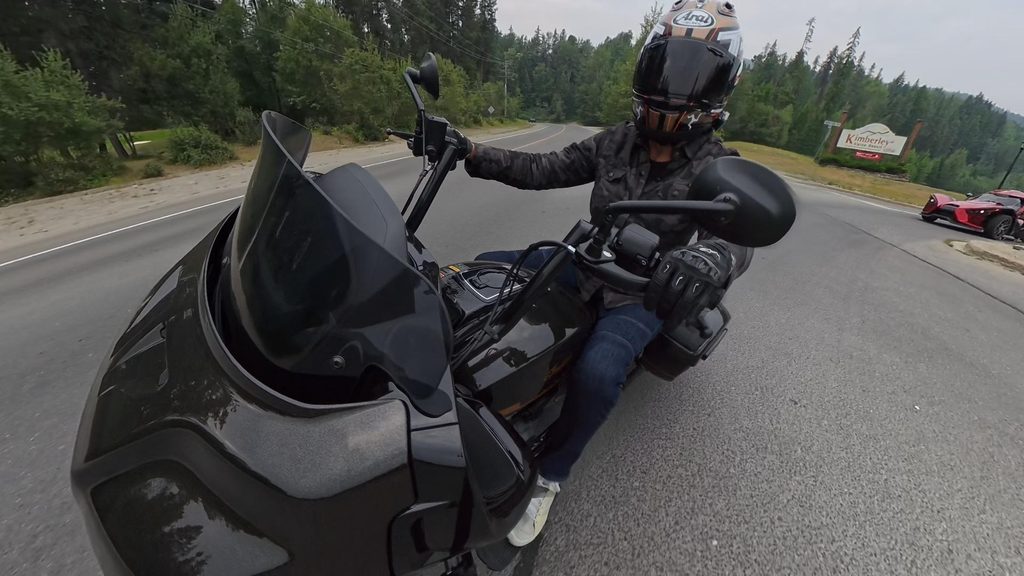
As much as I appreciated the Challenger’s effortless power delivery, finding the sweet spot for a comfortable cruising pace took a little experimentation.
With the performance modifications, particularly the Bassani 2-into-1 exhaust, the motorcycle had a personality all its own. Too light on the throttle and the exhaust would pop. Too heavy and the exhaust note became considerably more pronounced. It wasn’t a question of lacking power; there was plenty of that. It was finding the right balance between throttle position, engine speed and a comfortable exhaust note.
After approximately 45 minutes of experimenting, I finally found it. Fifth gear, 115 km/h, and an RPM that delivered a beautifully consistent ride. Everything seemed to settle into place.
Naturally, having discovered this magical combination, I decided it was the perfect time to engage the cruise control.
There was just one problem.
My hands had settled comfortably toward the outer ends of the ODI Hart-Luck grips, leaving my thumb just a little too far from the cruise control switch beside the grip. Normally, a slight adjustment of my hand position would have solved the problem. But these grips were doing their job almost too well. Their exceptionally secure hold made sliding my hand inward more of an exercise than I’d anticipated.
Apparently, the grips had a firmer grip on me than I had on the situation.
The irony wasn’t lost on me. I’d finally found the perfect cruising combination, but my thumb couldn’t quite reach the button that would let me enjoy it without maintaining the throttle myself.
It wasn’t a flaw in the cruise control or the handlebar arrangement. Had my hand been positioned closer to the inner end of the grip, the switch would have been perfectly accessible. Rather, it was one of those unexpected little discoveries that only becomes apparent after spending some time in the saddle.
And perhaps that’s what makes reviewing a customized motorcycle so interesting. Sometimes the smallest details leave the most memorable impressions.
The Riding Experience
Comfort on the Open Road
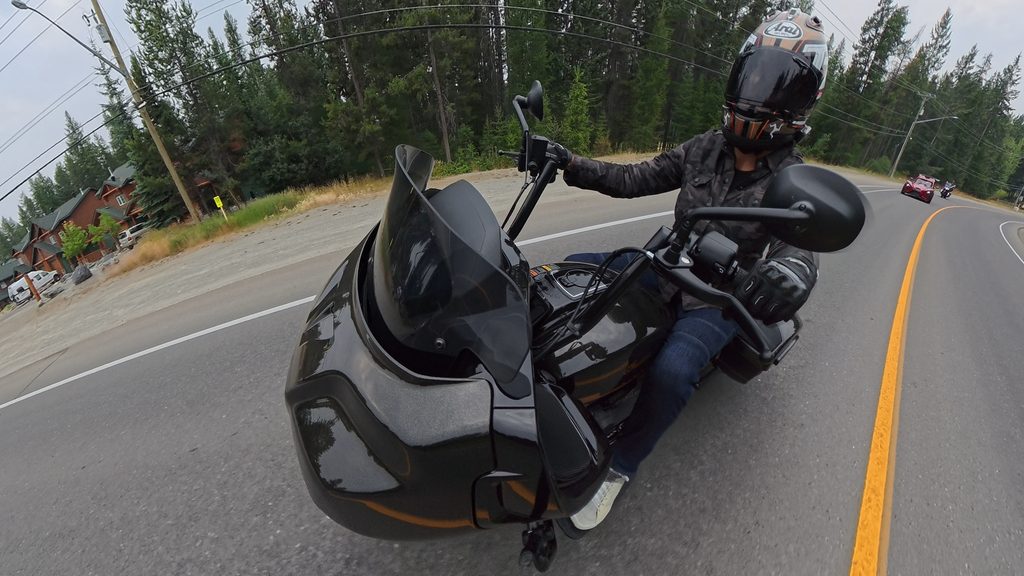
For all its size and substantial presence, the Challenger proved to be a remarkably comfortable companion on the open road. The seat was excellent, offering plenty of support while keeping me in a commanding riding position. There was no discomfort in my back or hips, and the motorcycle’s smooth power delivery made it easy to settle into the journey and enjoy the scenery unfolding through the Kootenays.
However, after approximately two hours in the saddle, my knee began to protest. I found myself wanting to stretch my leg forward, ideally onto a set of highway pegs mounted to the engine protection bars.
Unfortunately, this particular Challenger wasn’t equipped with them.
It’s a small accessory, but one I would certainly consider adding for longer journeys. Having the option to change leg position can make a considerable difference when spending hours in the saddle.
The seat certainly wasn’t the problem. In fact, I could have happily remained seated much longer. My knee simply wanted a little more freedom.
Handling and Cornering
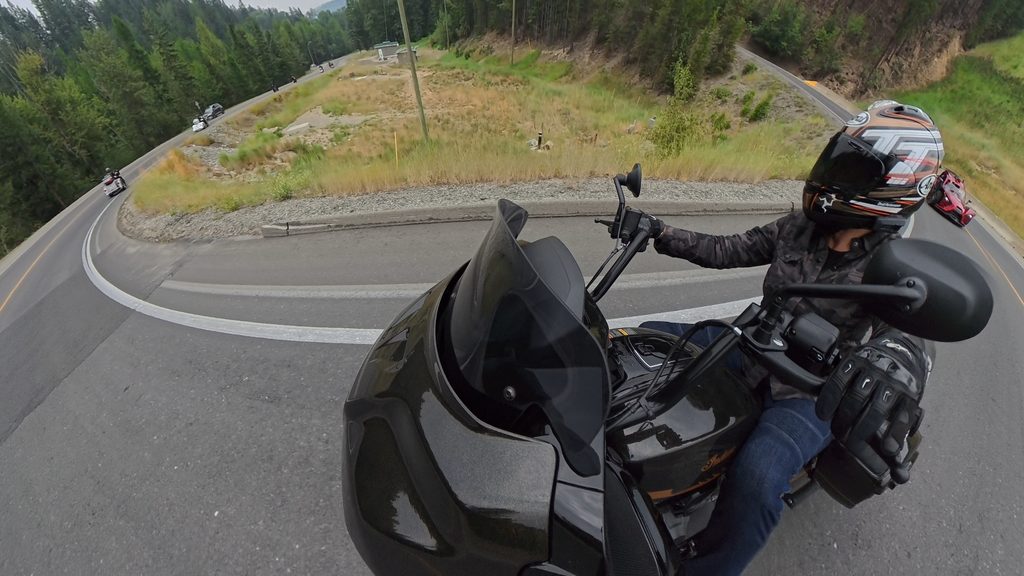
One of the biggest surprises was how effortlessly the Challenger handled the winding roads of the Kootenays.
There’s no disguising the fact that this is a substantial motorcycle, yet once underway, its size seemed to become far less relevant. Through the corners, the Challenger felt composed and remarkably easy to manage, allowing me to enjoy the curves rather than concentrate on the motorcycle’s weight.
At my cruising speed, I did notice the turbulence created by transport trucks travelling in the opposite direction. Their passing wake was enough to remind me of the air moving around a large motorcycle, particularly on open stretches of highway.
But through the corners, the Challenger was in its element.
And perhaps that shouldn’t have come as such a surprise.
After all, there’s a reason the Indian Challenger has earned four championship honours in the King of the Baggers racing series. While the race-prepared machines are a considerable departure from their street-going counterparts, the connection is an interesting one. The idea of a full-sized American bagger carving through corners with that kind of confidence suddenly doesn’t seem quite so improbable.
For a motorcycle I had initially considered too large for my preferences, the Challenger was doing an admirable job of changing my mind.
Conclusion: More Than I Bargained For
When I first requested an Indian Sport Chief RT for the Western Canadian Indian Motorcycle Riders Celebration, I had good reasons for wanting something smaller and more familiar. A full-sized bagger wasn’t exactly what I had in mind for exploring the winding roads of British Columbia’s Kootenays.
But the 2026 Indian Challenger had other plans for me.
What surprised me most wasn’t the sheer power of the PowerPlus 112, although there was certainly no shortage of that. It was how effortlessly the Challenger delivered that power and how confidently it handled the corners. For a motorcycle with such an imposing presence, it proved remarkably composed and enjoyable to ride.
The performance modifications gave this particular Challenger a distinctive personality. The Bassani exhaust demanded a little experimentation to find a comfortable cruising rhythm, while the ODI grips provided such a secure hold that even reaching for cruise control became an amusing challenge.
And although the seat was exceptionally comfortable, my knee would have appreciated a set of highway pegs after a couple of hours on the road.
These weren’t deal-breakers. They were the kinds of discoveries that come from spending meaningful time with a motorcycle rather than simply admiring it in a showroom.
Perhaps the biggest surprise was finding myself preferring Standard mode over Sport. Coming from a sport bike background, and regularly gravitating toward Sport mode when testing performance cars, that wasn’t something I expected. But the Challenger demonstrated that engaging performance doesn’t always require the most aggressive throttle response.
After 5 days in Kimberley, I’d developed a very different appreciation for this American bagger.
Would I still enjoy riding the Sport Chief RT? Absolutely. But I’m glad the Challenger was the motorcycle waiting for me.
Sometimes the motorcycle you didn’t ask for turns out to be the one that changes your expectations.
And this one certainly did.